 Tonkee Machinery Logo


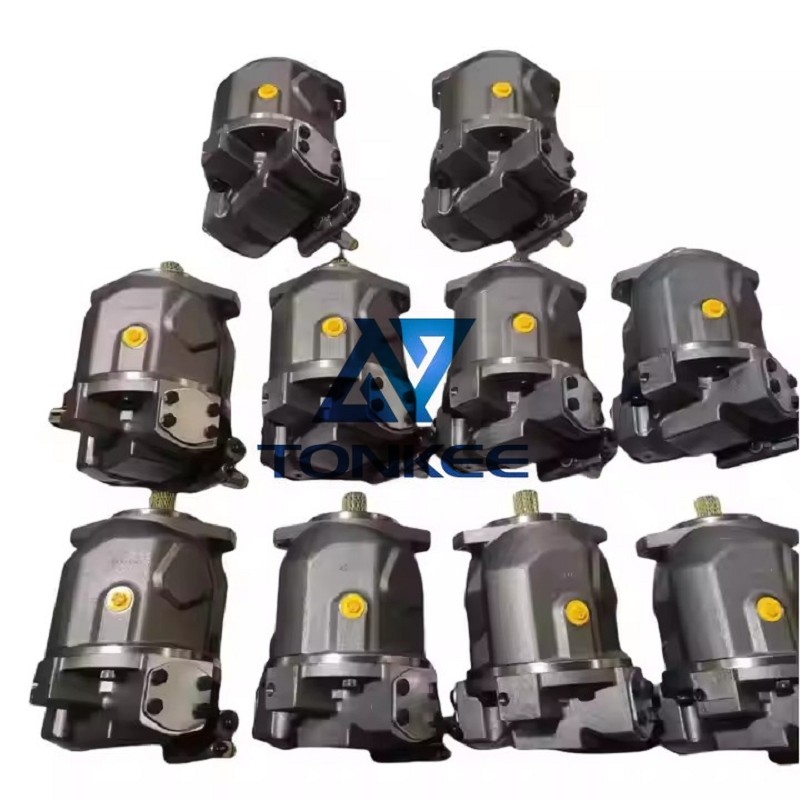
1. How to interpret the two models “A10VSO100DR/31R-VPA12K68” and “A10VSO100DFR/30R-PPA12N00” in detail?
| Model Segment | A10VSO100DR/31R-VPA12K68 Explanation | A10VSO100DFR/30R-PPA12N00 Explanation |
|---|---|---|
| A10VSO | Series Identifier: Axial Piston Variable Displacement Pump (High-pressure, industrial-grade, suitable for mobile and stationary hydraulic systems) | Same as left (Consistent series definition for A10VSO hydraulic pumps) |
| 100 | Nominal Displacement: 100 cm³/rev (cubic centimeters per revolution, indicating fluid volume displaced per shaft rotation) | Same as left (Both models share the same nominal displacement) |
| DR / DFR | Control Type: D = Dual control (pressure + flow); R = Hydraulic pilot pressure control (basic pressure-adjustable function) | D = Dual control (pressure + flow); FR = Hydraulic pilot control with pressure compensation (optimizes flow output based on load) |
| 31R / 30R | Mounting & Rotation: 31 = SAE 3-bolt flange (complies with SAE J744 Class 3); R = Clockwise rotation (viewed from shaft end) | 30 = SAE 2-bolt flange (complies with SAE J744 Class 2); R = Clockwise rotation (viewed from shaft end) |
| VPA12K68 | Configuration Code: VP = Integrated pressure relief valve; A12 = Relief valve setting (280 bar); K68 = Factory calibration code (optimized for heavy-duty working conditions) | PPA12N00 = PP = Integrated pressure relief valve; A12 = Relief valve setting (280 bar); N00 = Standard factory calibration (no custom modifications) |
2. What are the core technical parameters of the two pumps?
| Parameter | A10VSO100DR/31R-VPA12K68 | A10VSO100DFR/30R-PPA12N00 |
|---|---|---|
| Nominal Displacement | 100 cm³/rev | 100 cm³/rev |
| Maximum Working Pressure | 350 bar (5075 psi) | 350 bar (5075 psi) |
| Rated Working Pressure | 315 bar (4568 psi) | 315 bar (4568 psi) |
| Maximum Speed | 2200 rpm | 2200 rpm |
| Minimum Speed | 500 rpm | 500 rpm |
| Oil Viscosity Range | 10 – 400 mm²/s | 10 – 400 mm²/s |
| Recommended Oil Temperature | -20°C to +90°C (-4°F to 194°F) | -20°C to +90°C (-4°F to 194°F) |
| Oil Filtration Requirement | ≥ 10 μm (ISO 4406 Class 16/13) | ≥ 10 μm (ISO 4406 Class 16/13) |
| Shaft Diameter | 45 mm (1.77 in) | 45 mm (1.77 in) |
| Mounting Standard | SAE J744 (3-bolt flange) | SAE J744 (2-bolt flange) |
| Inlet/Outlet Port Size | Inlet: G1 1/2″, Outlet: G1 1/4″ | Inlet: G1 1/2″, Outlet: G1 1/4″ |
| Dry Weight | Approx. 65 kg (143.3 lbs) | Approx. 62 kg (136.7 lbs) |
| Volumetric Efficiency | ≥ 95% | ≥ 95% |
| Mechanical Efficiency | ≥ 92% | ≥ 92% |
3. What are the key differences between the two models?
- Control Type: The A10VSO100DR adopts basic hydraulic pilot pressure control (DR), which is suitable for systems requiring simple pressure adjustment. The A10VSO100DFR uses hydraulic pilot control with pressure compensation (DFR), which can automatically adjust flow according to load changes, improving energy efficiency by 15 – 20% compared to the DR type.
- Mounting Flange: The A10VSO100DR is equipped with an SAE 3-bolt flange (31), which has higher connection stability and is suitable for heavy-vibration equipment (e.g., construction machinery). The A10VSO100DFR uses an SAE 2-bolt flange (30), which is more compact and suitable for space-constrained industrial equipment.
- Calibration & Weight: The A10VSO100DR has a K68 heavy-duty factory calibration, making it more durable in high-load scenarios, while the A10VSO100DFR uses N00 standard calibration for general working conditions. Due to the flange difference, the A10VSO100DR (65 kg) is slightly heavier than the A10VSO100DFR (62 kg).